Zens King: The Definitive Guide to Urban Graffiti Typography
In the landscape of graphic design, typography is rarely just about legibility; it is about voice. When a designer selects a typeface, they are choosing the tone, the accent, and the attitude of the message. For projects requiring a visceral, raw, and energetic impact, standard serif or sans-serif fonts often fall flat. This is where the realm of display typography takes over, specifically within the niche of street-style aesthetics. Among the tools available to modern creatives, Zens King has emerged as a formidable contender, offering a distinct graffiti marker aesthetic that bridges the gap between underground art and professional design utility.
Understanding the technical and artistic nuances of Zens King requires more than a cursory glance. It involves analyzing its construction, its extensive glyph set, and the specific contexts where its "rebellious edge" translates into effective visual communication. This guide explores the anatomy of this font, its practical applications across various industries, and the technical considerations necessary for seamless implementation.
The Anatomy of the Marker Style
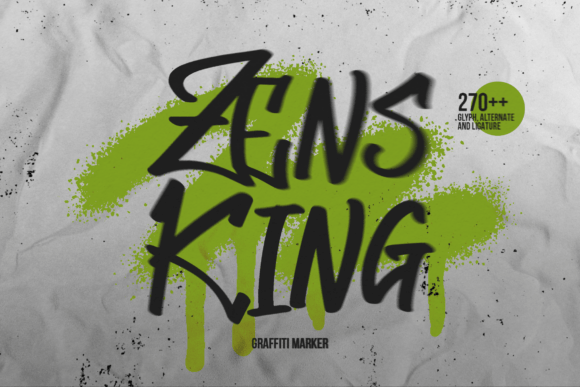
To appreciate Zens King, one must first understand the mechanics of the tool it emulates: the broad-tipped marker. Traditional graffiti writing relies heavily on the physics of the tool. A chisel tip marker creates thick downstrokes and thin horizontal strokes based on the angle of the hand. Zens King captures this organic variance digitally. It features expressive brush strokes that mimic the pressure and speed of a human hand moving across a surface.
However, the defining characteristic of this typeface is not just the stroke, but the texture. The font incorporates "splattered ink effects." In the physical world, markers can bleed, drip, or splatter when hitting uneven surfaces like concrete or cardboard. By integrating these imperfections into the vector paths, Zens King avoids the sterile, manufactured look of standard digital fonts. This texture adds a layer of authenticity that is difficult to achieve with post-processing filters alone.
Anatomy of the Glyphs
The utility of a display font is often measured by its versatility. A common limitation of novelty fonts is a lack of character variation, leading to repetitive patterns that break the illusion of hand-drawn art. Zens King addresses this with an extensive library of over 270 glyphs. This collection includes:
- Alternates: Different versions of the same letter. If a designer uses the letter 'a' twice in a headline, they can select two different variations to prevent repetition.
- Ligatures: Special characters that combine two or more letters into a single unit. These are crucial in graffiti typography to create the "flow" or "connection" between letters that defines the style.
- Stylistic Sets: Collections of variant letters that share a specific design characteristic, allowing for global changes in the text's mood.
Strategic Applications: Where Zens King Fits
While the aesthetic of Zens King is clearly rooted in urban culture, its application extends beyond simple street art reproduction. The font serves as a strategic asset for various sectors aiming to connect with specific demographics or convey specific emotional states.
Streetwear and Fashion Branding
The fashion industry, particularly the streetwear sector, relies heavily on typography to establish brand identity. Labels that target youth culture, skate communities, or hip-hop enthusiasts often utilize fonts like Zens King to signal authenticity. When applied to t-shirt graphics, hoodie prints, or accessory tags, the font communicates a sense of rebellion and individuality. It suggests that the brand is not part of the corporate establishment but rather an extension of the street.
Music Industry and Album Art
Visual identity in the music industry is paramount. For genres such as hip-hop, punk, rock, and electronic dance music (EDM), the album cover is a visual extension of the sound. Zens King is particularly effective for music covers and promotional posters. The "bold and edgy" nature of the font visually represents high-energy music. It creates an immediate association with the rawness of live performance and the grit of the underground scene.
Event Promotion and Poster Design
In a crowded visual environment, such as a city street plastered with flyers or a social media feed scrolling rapidly, attention is a scarce resource. Zens King possesses a high "stopping power." Its irregular shapes and heavy weight make it instantly readable from a distance. This makes it ideal for posters advertising concerts, skate competitions, pop-up shops, or urban festivals. The font does the heavy lifting of grabbing attention, allowing the designer to use smaller, more legible fonts for the necessary details like dates and locations.
Technical Implementation and Design Workflow
Integrating a complex font like Zens King into a professional workflow requires an understanding of OpenType features and layout composition. Because the font is designed to be "dynamic," static usage often underutilizes its potential.
Leveraging OpenType Features
To keep designs "fresh and dynamic," designers must access the alternate glyphs. In professional design software like Adobe Illustrator or Photoshop, this is done via the Glyphs panel or the OpenType settings. By manually swapping standard characters for alternates, or by utilizing the ligatures, a designer can simulate the look of custom hand-lettering. This is particularly useful for logos, where a unique configuration of letters is essential for trademark distinctiveness.
Visual Hierarchy and Contrast
Because Zens King is a display font with high visual noise (splatters and brush textures), it should rarely be used for body copy. Its strength lies in headlines, logos, and short bursts of text. Effective design pairs Zens King with a clean, neutral typeface. For example, using a geometric sans-serif for body text provides a visual rest for the eye, allowing the headline set in Zens King to have maximum impact without causing visual fatigue.
Color Theory and Backgrounds
The "ink effects" in Zens King are best showcased against high-contrast backgrounds. While black on white is classic, the font often shines when used in monochromatic schemes (white on black) or neon colors against dark, textured backgrounds that mimic concrete or asphalt. Designers should be cautious about placing the font on busy photographic backgrounds, as the intricate details of the letters can get lost in the noise of the image.
Psychological Impact and Audience Perception
Typography triggers psychological responses. The "rebellious edge" of Zens King is not just a marketing phrase; it is a psychological trigger. For a broad audience, including consumers and educators, understanding this trigger is key to effective communication.
- For Youth Audiences: The font signals authenticity, coolness, and a break from tradition. It resonates with the desire for self-expression and non-conformity.
- For General Audiences: It signals energy, excitement, and informality. It warns the viewer that the content is likely entertaining, creative, or unconventional.
- For Business Owners: Using such a font requires careful brand alignment. A law firm using Zens King would likely confuse clients, but a creative agency or a coffee shop might use it to appear approachable and edgy.
Considerations for Professional Use
While the aesthetic appeal of Zens King is high, there are practical considerations for its deployment.
Readability vs. Legibility
In typography, legibility refers to the ability to distinguish one letter from another, while readability refers to the ease of reading blocks of text. Zens King prioritizes style over strict legibility in some of its alternate forms. While the standard set is designed for clarity, the more expressive alternates may require the viewer to spend a moment deciphering the word. This is acceptable for logos or display headers but poses a risk if used for critical information like instructions or safety warnings.
File Formats and Compatibility
To access the full suite of 270+ glyphs and alternates, the font must be used in software that supports OpenType (OTF) features. Basic text editors or older web platforms may not render the ligatures correctly, potentially displaying standard, less stylized characters instead. Designers must ensure their workflow supports the advanced features of the font to justify the investment.
Cultural Context
Graffiti is a complex cultural form with deep roots in protest and expression. While Zens King commercializes this aesthetic, designers should be mindful of context. Using a graffiti font to sell a product that contradicts the values of street culture (e.g., luxury gentrification) can be perceived as tone-deaf or appropriative. Authenticity in design comes from understanding the source material.
The Versatility of Urban Flair
Despite the specific niche of graffiti, the versatility of Zens King allows it to cross boundaries. Its "urban flair" can be adapted to various themes beyond strict hip-hop culture.
Retro and Vintage Vibes
Depending on the color palette, Zens King can evoke a sense of 1990s nostalgia. The marker style was prevalent in the skater and punk scenes of that era. By pairing the font with retro color schemes (pastels or washed-out neons) and grainy textures, designers can create throwback designs for vintage clothing lines or retro-themed events.
Experimental Layouts
The "expressive brush strokes" allow for dynamic layout compositions. Unlike rigid block fonts, Zens King can be rotated, scaled, and overlapped to create energetic compositions. This is particularly useful in collage-style design, where text interacts with torn paper edges, spray paint splashes, and halftone photography.
Conclusion: The Role of Zens King in Modern Design
The landscape of digital typography is vast, but specific niches require specific tools. Zens King fills the void for designers seeking a tool that is not just a font, but a texture, a mood, and an attitude. Its comprehensive glyph set ensures that it remains a workhorse for creative professionals, offering enough variation to keep projects unique.
For streetwear brands, music artists, and event promoters, Zens King offers a direct line to the visual language of the streets. For educators and researchers in design, it serves as a case study in how digital tools can replicate and amplify the imperfections of analog art. By understanding its technical capabilities and psychological impact, users can harness the "rebellious edge" of Zens King to create designs that are not only seen but felt.