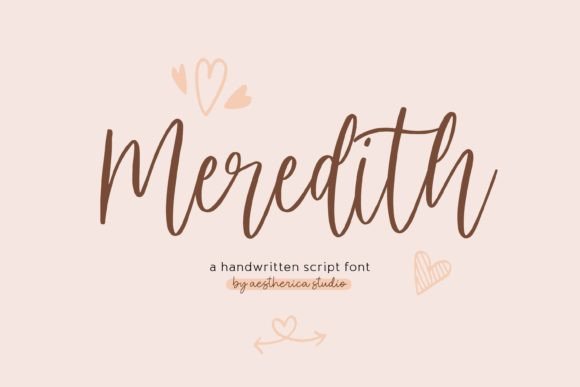
Meredith: The Handwritten Script Font for Natural Beauty
In a digital world saturated with clean, geometric sans-serifs and rigid serifs, there's a growing hunger for authenticity. We crave the human touch, the imperfect beauty of a hand-lettered note, the warmth that automated fonts often lack. This is where a typeface like Meredith steps in. More than just a collection of letters, Meredith is a handwritten script font meticulously crafted by typographic experts to capture the genuine, flowing elegance of natural handwriting. Its value lies not in technical precision, but in its ability to evoke emotion, create connection, and deliver a distinct personality that standard fonts simply cannot replicate.
Why Choose a Handwritten Script Like Meredith?
The decision to use a font like Meredith isn't merely aesthetic; it's strategic. A well-designed handwritten script serves as a visual shorthand for authenticity, care, and personal connection. When a brand uses Meredith on its packaging, it signals that there's a real person or a dedicated craft behind the product. For a wedding invitation, it conveys intimacy and bespoke elegance. In social media graphics, it cuts through the algorithmic noise with a human voice. The beautiful and natural flow of Meredith's letterforms is engineered to feel effortless, yet its construction by experts ensures it remains highly legible and versatile across various sizes and applications. This balance is crucial; a font that is too chaotic or hard to read fails its primary purpose, no matter how charming.
Practical Applications: Where Meredith Shines
The true test of any typeface is its utility. Meredith's strength lies in its broad yet specific applicability. It excels in projects where the handwriting taste is not just a decorative element, but a core component of the message.
For Branding and Entrepreneurship
Small business owners and entrepreneurs can leverage Meredith to build a brand identity that feels approachable and artisanal. Imagine a local bakery using Meredith for its logo and menu boards—the font instantly communicates homemade quality. For a freelance graphic designer or a consultant, incorporating Meredith into their personal logo or website header can soften a professional image, making it more relatable. It’s particularly effective for businesses in the wedding industry, artisanal goods, boutique studios, and wellness sectors, where a personal touch is a key selling point. However, it's wise to pair Meredith with a clean, simple sans-serif for body text to ensure maximum readability in longer paragraphs.
Elevating Design and Creative Projects
Creatives and marketers find Meredith invaluable for specific design tasks. Its charming handwriting feel is perfect for creating standout social media posts, especially quotes, announcements, or calls-to-action that need an emotional pull. In product packaging and label design, a word or phrase set in Meredith can highlight a key ingredient, a special feature, or the product name itself, drawing the consumer's eye and adding perceived value. Photographers and artists use it subtly as a watermark that doesn't distract, or on prints and certificates to add a signature-like quality. For advertisements, particularly those aimed at a lifestyle or craft audience, Meredith can make headlines feel more like a friendly suggestion than a hard sell.
Personal Celebrations and Communication
Perhaps where Meredith feels most at home is in deeply personal projects. For wedding designs—from save-the-dates and invitations to programs and thank-you cards—this font sets a tone of romantic, timeless elegance. Its natural flow mimics the care taken in hand-addressing envelopes. Similarly, for stationery, greeting cards, and personal blogs, Meredith allows individuals to inject their unique personality into their communications. Educators and hobbyists might use it for crafting beautiful quotes, journal headers, or project titles that inspire creativity.
Considering the Fit: When Meredith Might Not Be the Answer
While Meredith is versatile, it is not a universal solution. Understanding its limitations is key to using it effectively. As a script typeface, it is not ideal for long blocks of body text. Its intricate letterforms can become fatiguing to read in lengthy paragraphs, and at very small sizes, details may become unclear. For legal documents, technical manuals, or extensive website copy, a more conventional serif or sans-serif remains the better choice. Furthermore, its handwritten nature may not align with brands or projects that require an image of extreme formality, cutting-edge technology, or stark minimalism. In such cases, comparing Meredith against more geometric or industrial fonts would be necessary.
Integrating Meredith into Your Workflow
For professionals and creators considering Meredith, a thoughtful approach yields the best results. Start by identifying the specific touchpoints where a natural, beautiful handwriting feel would most benefit your project. Use it selectively for headlines, logos, pull quotes, or accent words. Test it across different mediums—what looks beautiful on a printed invitation may need slight size adjustments for a mobile screen. Always ensure there is sufficient contrast between the text and the background to maintain legibility. Pairing Meredith with complementary fonts is also a skill; it often pairs well with light, airy sans-serifs or classic, low-contrast serifs that don't compete for attention.
Ultimately, the choice to use a font like Meredith is a choice to prioritize human connection and aesthetic warmth in your visual communication. It’s a tool for designers, marketers, and individuals who understand that sometimes, the most powerful message is one that feels personally crafted. By applying it thoughtfully to the right projects, you can harness its expert-crafted beauty to create work that resonates on a deeper, more personal level with your audience.